
Durham State Trial Courts
North Carolina has an Appellate Division, a Superior Court Division, and a District Court Division. Durham County trial work is divided between Superior Court and District Court, with the Clerk of Superior Court serving both divisions. The courthouse at 510 South Dillard Street is the local hub for the Clerk, Superior Court, District Court, criminal and traffic records, civil filings, family court, estates, special proceedings, jury assembly, and magistrate functions.
Superior Court handles felony crimes, civil cases generally involving $25,000 or more, appeals from District Court, and some special proceedings or administrative matters by statute. District Court handles misdemeanors, infractions, traffic, small claims, most domestic and family cases, juvenile matters, involuntary commitments through magistrate or court process, and civil cases within District Court jurisdiction. Appeals from trial courts generally route to the North Carolina Court of Appeals unless direct Supreme Court review applies.
The Durham Recovery Court page shows one local court-connected program serving eligible participants.
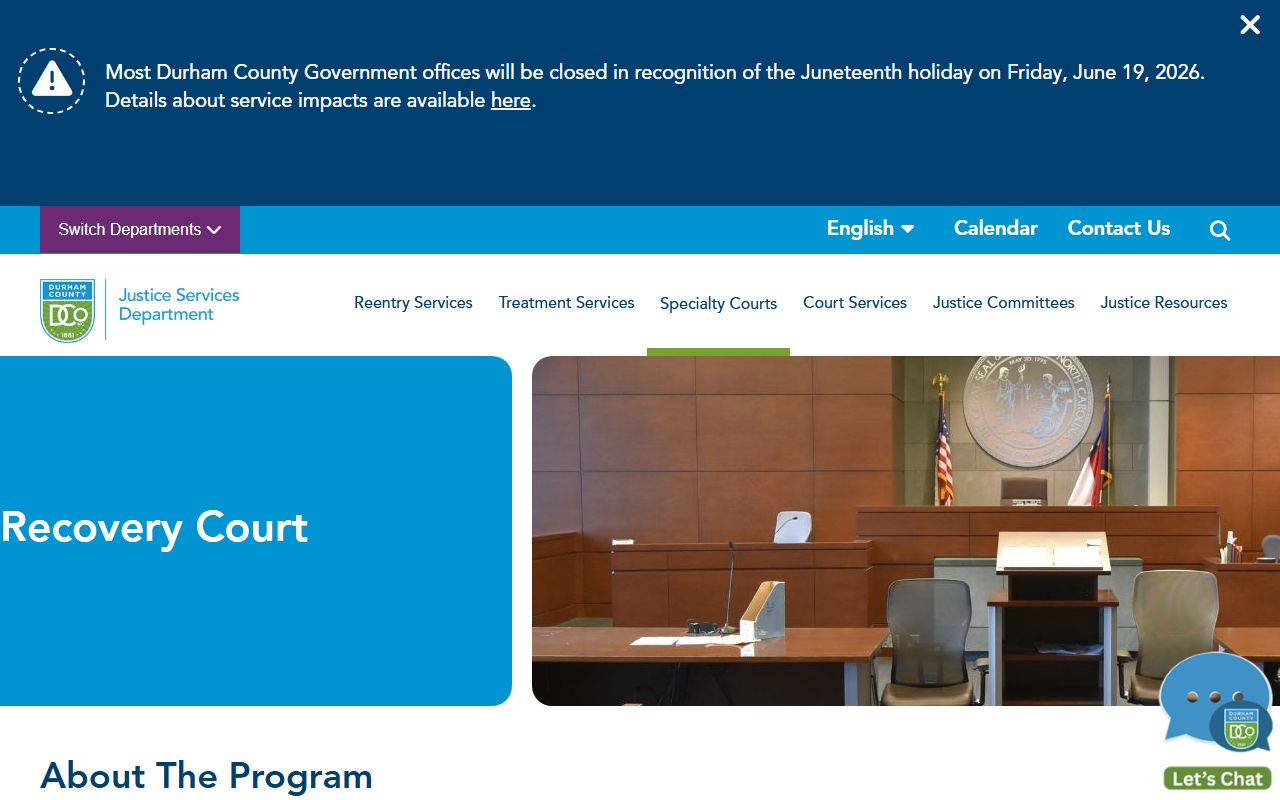
Specialty court material does not replace normal jurisdiction rules, but it shows how Durham court operations include supervised alternatives in selected cases.
Durham Court Contact Table
Durham County does not list separate numbered district courts like some states do. Instead, the official contact structure is by division, office, or court function at the Durham County Courthouse. The table uses the researched official contacts rather than inventing numbered courts.
| Court or function | Address or room | Phone | Primary role |
|---|---|---|---|
| Durham County Courthouse main | 510 S. Dillard St., Durham, NC 27701 | 919-808-3000 | Main courthouse and Clerk access point. |
| Clerk of Superior Court | 510 S. Dillard St. | 919-808-3000 | Records, filings, copies, dockets, estates, special proceedings. |
| Superior Court Judges | Courthouse | 919-808-3016 / 919-808-3240 | Superior Court division functions. |
| District Court Judges | Courthouse | 919-808-3012 / 919-808-3200 | District Court division functions. |
| District Attorney | 510 S. Dillard St., 8th Floor | 919-808-3010 | State prosecution in Durham County. |
| Civil Magistrates / Small Claims | 3rd Floor M1-M3 | 919-808-3013 | Small claims, summary ejectment, and civil magistrate matters. |
| Criminal Magistrates / Warrants | Courthouse / magistrate contact | 919-560-6826 / 919-808-3019 | Warrants, initial process, and involuntary commitment contacts. |
| Family Court Administration | Courthouse | 919-808-3015 | Family case administration. |
| Trial Court Administration | Courthouse | 919-808-3017 | Trial court administration and access coordination. |
Durham Superior District Magistrates
Durham's primary trial court structure is a state-court structure, not a county court system with separate county courts or justice courts. The proper comparison is Superior Court, District Court, and magistrate functions. Municipal payment or ordinance channels may exist in city contexts, but state court case records and court dockets remain with the North Carolina court system and Clerk of Superior Court.
| Point | Superior Court | District Court | Magistrates |
|---|---|---|---|
| Civil jurisdiction | Generally $25,000 or more and appeals from District Court. | Small claims, domestic, and civil cases within District Court jurisdiction. | Small claims and summary ejectment hearing functions. |
| Criminal jurisdiction | Felonies and superior criminal files. | Misdemeanors, infractions, traffic, and lower criminal matters. | Warrants, initial process, first appearance or conditions in many matters. |
| Family and juvenile | Limited by case type and appeal posture. | Most domestic, family, and juvenile matters. | Not the main forum for family litigation. |
| Records office | Clerk of Superior Court. | Clerk of Superior Court. | Clerk or magistrate-related court channels depending on record type. |
Durham Case Flow Diagram
A Durham case moves through different offices depending on case type. Criminal cases may start with law enforcement and a magistrate, then move through District Court or Superior Court. Civil cases begin with filings at the Clerk, then move through hearings, orders, judgments, and appeals when allowed. Probate and some special proceedings begin with the Clerk acting as Judge of Probate.
Criminal flow: Arrest or process › Magistrate or first appearance › District Court or indictment path › Superior Court for felony matters › Plea or trial › Disposition and sentence › Appeal.
Civil flow: Complaint or petition › Service › Answer or response › Motions or mediation where required › Hearing or trial › Judgment › Appeal.
Probate flow: Estate or special proceeding filing › Clerk review › notices or hearings where required › letters, orders, inventories, accountings, or final disposition.
Durham Court Divisions
Durham local rules show separate local procedures for Superior Court, District Court, Domestic Court, and Juvenile Court. The local forms list includes notice of address change, notice of appearance, calendar request, notice of hearing, motion and order to continue, objection to continuance, extension of time, pre-arbitration submission, domestic affidavit for judicial assignment, domestic calendar request, peremptory setting, and emergency custody consideration. These details show that Durham court administration is divided by local case-management needs, even though the state court structure is uniform.
Criminal and traffic contacts are also split by level. District Criminal/Traffic Records handles criminal and traffic dates, citation payments, limited driving privileges tied to DWI or in-state speeding, bond forfeitures, and vehicle seizures. Superior Criminal handles CRS bond forfeitures, superior criminal dates and courtrooms, attorney information, and copies of CRS files. That distinction matters when searching Durham County court records because a misdemeanor traffic matter and a felony CRS file do not use the same counter.
Note: Juvenile, adoption, sealed, expunged, and mental-health records are restricted and are not ordinary public case files.
Durham Magistrate Functions
Magistrates are judicial officials in the Durham County court system. The research identifies civil magistrates in 3rd Floor M1-M3 for civil magistrate functions, landlord-tenant matters, and small claims. Criminal magistrates handle warrants, involuntary commitments, and other initial criminal process functions. City of Durham situational warrant guidance directs complainants to the Durham County Magistrate's Office at the jail for citizen-initiated warrant situations, but court records tied to those proceedings still connect back to the Clerk and state court case systems when filed.
Magistrate work often appears early in a case. A warrant, criminal summons, bond condition, small-claims judgment, or summary ejectment order may become part of a later court record. Use eCourts or clerk terminals for filed case information, and contact the magistrate or Clerk department when the matter is urgent, pending, sealed, or not yet visible online.
Durham Federal Court Caveat
Durham County also has a federal courthouse, but federal cases are not Durham County Superior Court or District Court records. Durham is in the U.S. District Court for the Middle District of North Carolina. The federal Durham location is the John Hervey Wheeler Courthouse at 323 E. Chapel Hill Street. Federal civil, criminal, and bankruptcy records are searched through PACER and federal CM/ECF channels, not through the Durham County Clerk of Superior Court or North Carolina eCourts.
The U.S. District Court for the Middle District of North Carolina is the federal court source.
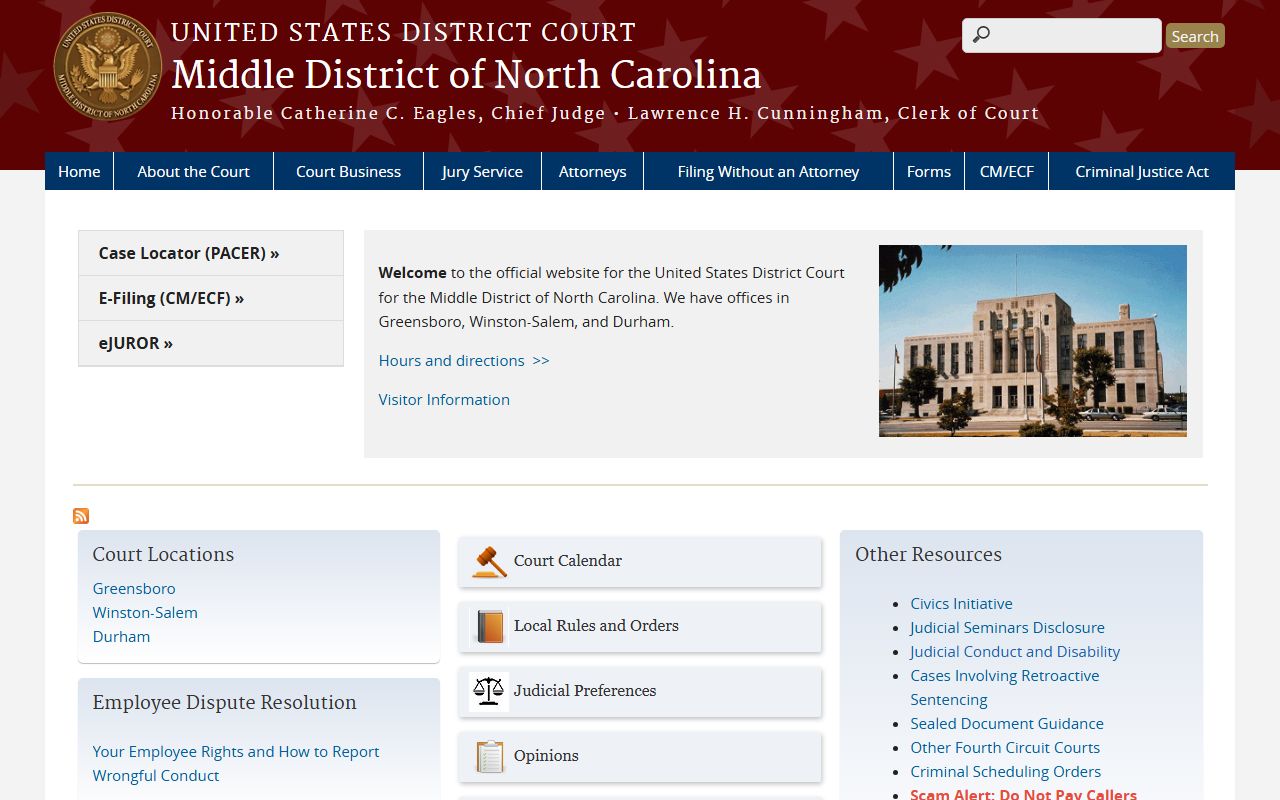
Use this source only for federal cases, not for Durham County state trial court files.
The Durham federal courthouse page lists the local federal courthouse information.
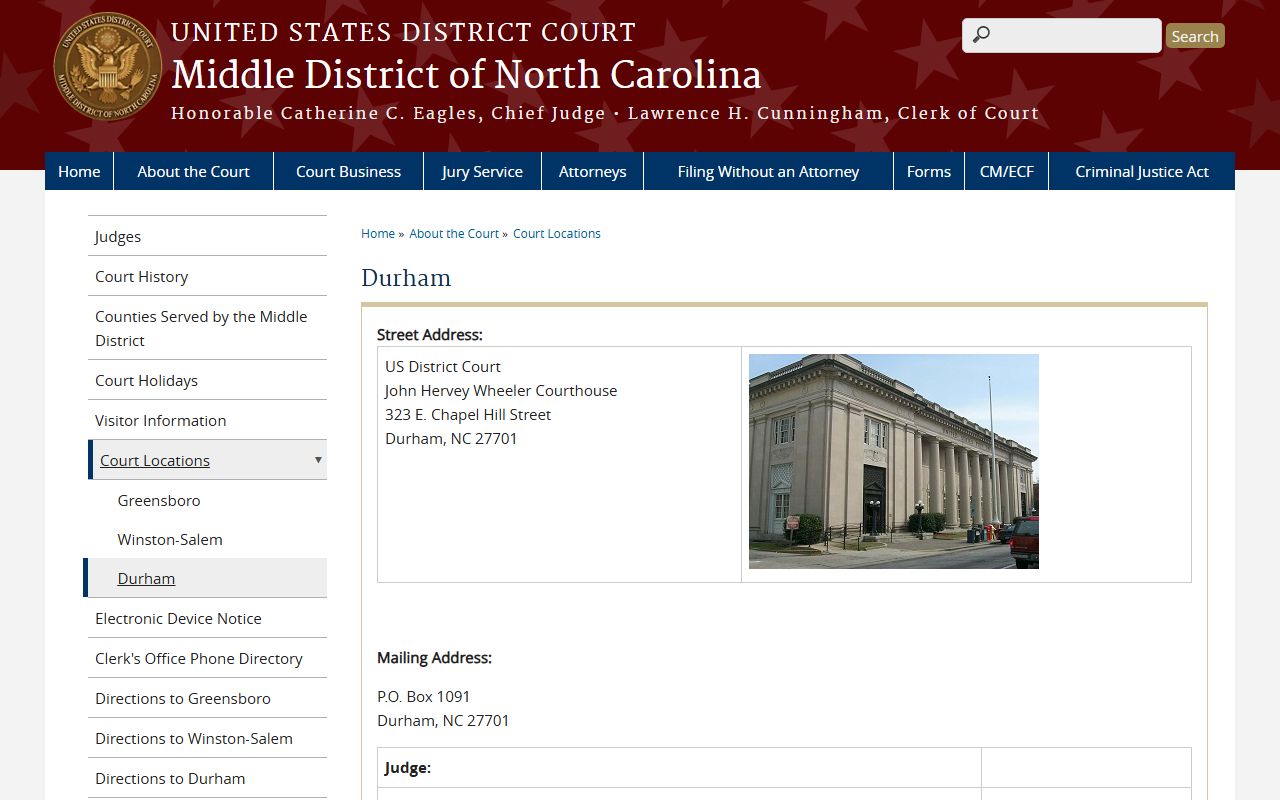
The federal address can help with venue questions, but the records system remains separate from Durham County state court records.
PACER is the official federal public access system for federal electronic records.
PACER access is for federal dockets and documents, so it should not be used as a substitute for a Durham County state court case search.