
Search Durham County Court Records
Most public Durham County court records are searched through the North Carolina eCourts Portal. Smart Search covers public case information by name, case number, attorney, citation, and other fields. Search Hearings is the calendar tool for court dates, hearing locations, judicial officers, and courtrooms. NC Judgment Search is a separate index for judgment records, and the payment tool handles eligible criminal and infraction financial obligations.
The Durham records access materials warn that the Portal is not the right source for a formal background check. For certified copies, complete paper files, older records, or records that do not display online, the Clerk of Superior Court remains the access point. Public terminals at clerk offices can also be used for criminal, civil, special proceeding, and estate case information.
- Open the eCourts Portal and choose Smart Search for court case information or Search Hearings for calendar information.
- Search by party name, case number, attorney, citation, or business name. Use Durham County as the location filter when the option appears.
- Use the Enterprise Justice case number format when known: two-digit year, case type letters, six-digit sequence, and county identifier.
- Review the case summary, docket events, parties, filing date, status, hearings, financial entries, and public documents.
- Contact or visit the Clerk of Superior Court when a certified copy, older paper file, transcript, or background-check search is needed.
The NC Judicial Branch Portal training page gives useful wildcard rules. A name search can use at least three last-name characters plus an asterisk and at least one first-name character plus an asterisk. Business names and case numbers generally need at least four characters plus an asterisk for wildcard searching.
Durham County Courthouse Access
The Durham County Courthouse is the local hub for Superior Court, District Court, the Clerk of Superior Court, criminal and traffic records, civil filings, family court, estates, special proceedings, magistrates, jury assembly, and many in-person file reviews. The Register of Deeds is nearby but separate, which matters for marriage certificates and vital records.
The official Durham County Courthouse page confirms the address, public hours, accessible entry details, interpreter help, and main phone line.
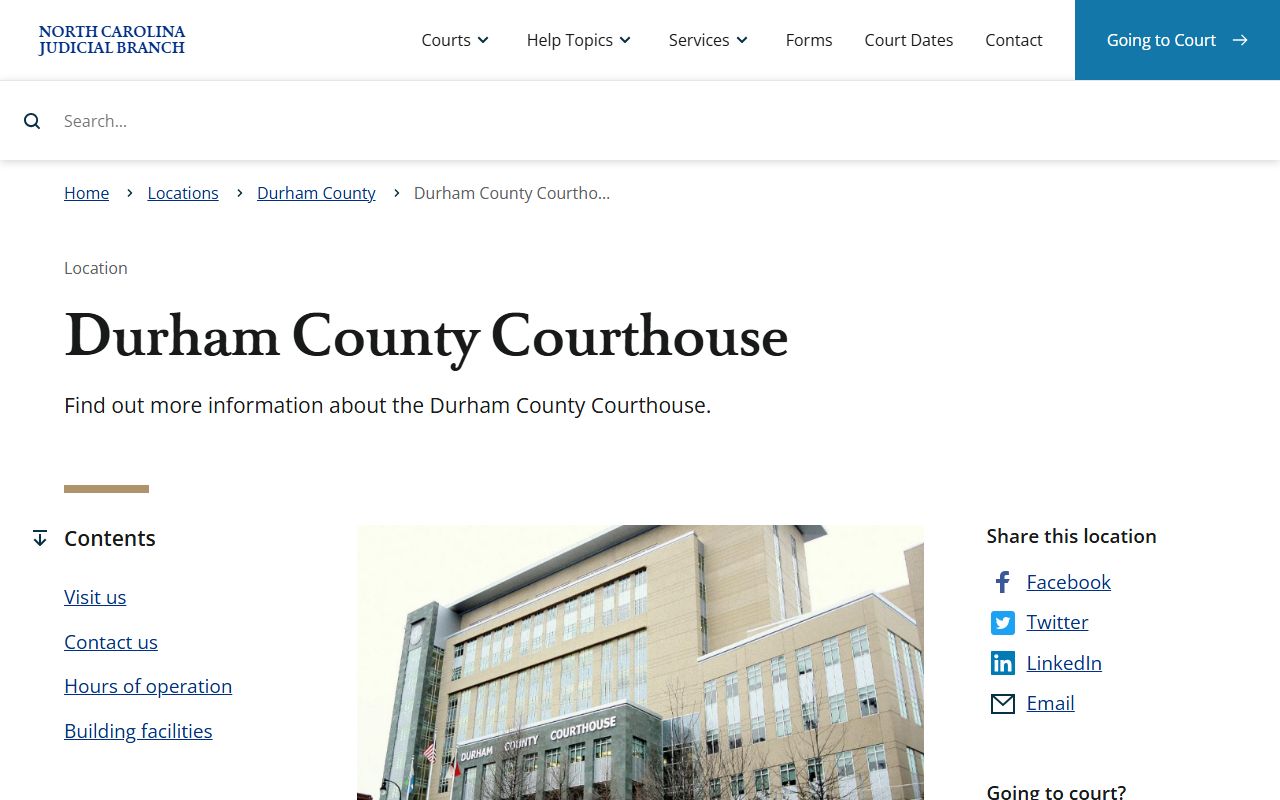
That courthouse source is the best starting point for confirming entry rules, ADA access, and current public hours before visiting the Durham County Clerk or a courtroom.
Durham County Courthouse
510 South Dillard Street
Durham, NC 27701
919-808-3000
Monday-Friday, 8:30 a.m.-5:00 p.m.
Clerk of Superior Court
510 S. Dillard St.
Durham, NC 27701
919-808-3000
Courier box 17-3504
Register of Deeds
201 East Main Street, 2nd Floor
Durham, NC 27701
919-560-0480
Marriage and vital records office
Which Durham Office Holds Records
Durham County records are split by record type. Court files are not county-government records in the same way budget, permit, or department records are. The Clerk of Superior Court keeps court case files for Superior Court and District Court. The Register of Deeds handles marriage certificates, birth and death certificates, military records, and land records. The Sheriff's Office keeps jail and sheriff records, while the District Attorney handles prosecution decisions after arrest.
The Durham County court contact directory is the official phone list for clerk units, judges, magistrates, family court, trial court administration, and the District Attorney.
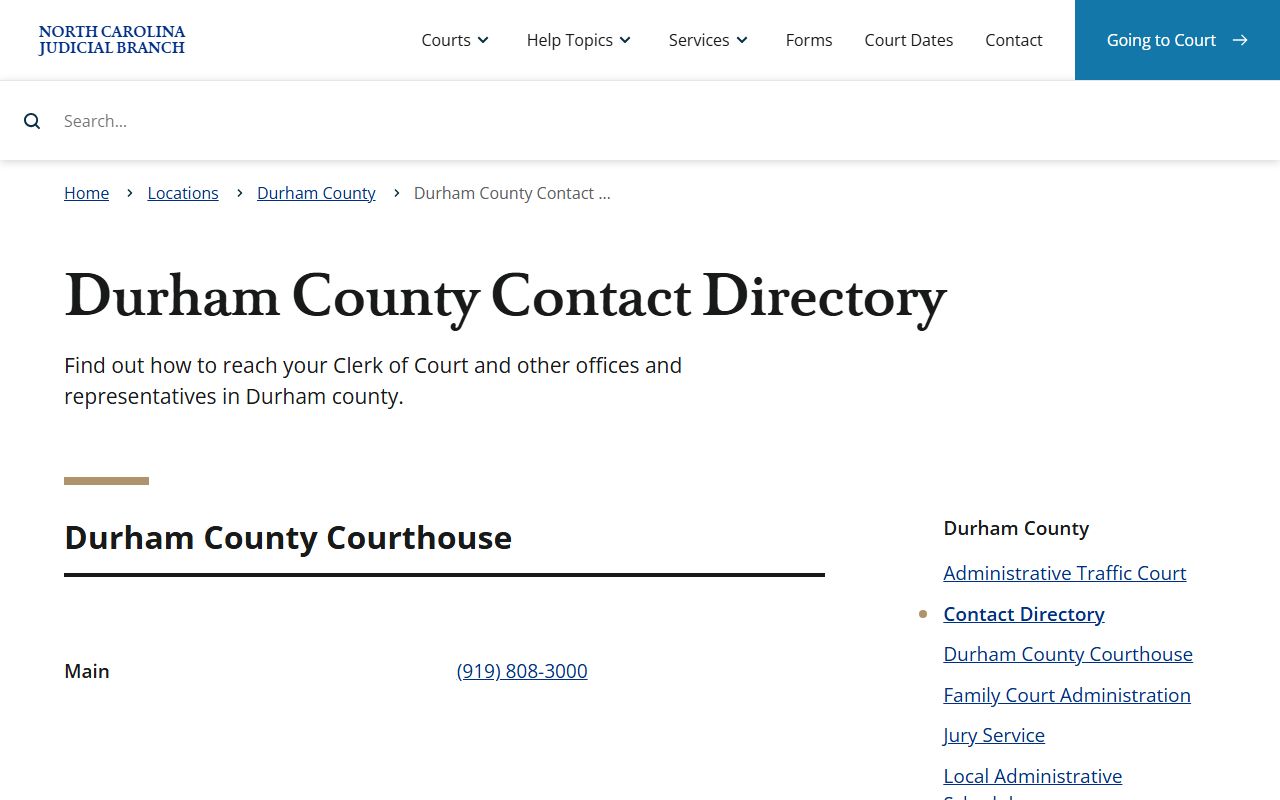
Because Durham County lists room-specific court contacts, a reader can often route a records question to the correct department without starting at a generic switchboard.
| Record Need | Durham Office | Search or Request Channel |
|---|---|---|
| Civil, criminal, family, traffic, estate, and judgment case records | Clerk of Superior Court | eCourts Portal, public terminal, in-person clerk request |
| Marriage licenses and certified marriage certificates | Register of Deeds | Appointment, online application, Permitium vital records ordering |
| Current jail custody and booking charge lines | Durham County Sheriff's Office | Inmate population search, VINE, sheriff records request |
| Warrant status | Sheriff CID or magistrate channel | Phone channel, magistrate office, later court or jail record |
| County department records | Durham County departments | NextRequest, unless the record is held outside that portal |
Durham County Court Structure
North Carolina has an Appellate Division, Superior Court Division, and District Court Division. Durham County trial matters are split between Superior Court and District Court, both served by the Clerk of Superior Court. Superior Court handles felony crimes, larger civil cases, appeals from District Court, and some matters assigned by statute. District Court handles misdemeanors, infractions, traffic, small claims, most domestic and family cases, juvenile matters, and lower civil cases.
The NC court structure overview and the court type summary explain how the Durham County Court system fits into the statewide judiciary.
Statewide structure matters locally because Durham does not run a separate home-rule county court for ordinary trial records.
The state court type source also shows how Superior Court and District Court divide trial work across North Carolina.
That division is why a Durham traffic infraction, felony case, estate, and small claim can have different search paths even though they share one statewide court system.
Case flow: Magistrate or District Court start › District Court or Superior Court trial division › North Carolina Court of Appeals › Supreme Court of North Carolina when review is allowed or required.
| Court or Function | Durham County Role | Common Record Types |
|---|---|---|
| Superior Court | Felonies, higher-value civil cases, District Court appeals | CRS criminal files, civil judgments, motions, orders, sentencing |
| District Court | Misdemeanors, infractions, traffic, small claims, family, juvenile | Citations, domestic filings, small claims, juvenile records where authorized |
| Magistrates | Initial criminal process, warrants, small claims, some marriage ceremonies | Warrants, first appearance notes, summary ejectment matters |
| Clerk as Judge of Probate | Estates, wills, guardianships, adoptions, foreclosures, partitions | Estate files, special proceedings, probate orders, inventories |
Durham County Court Record Types
Durham County court records include criminal, civil, family, probate, traffic, juvenile, judgment, lien, and special proceeding files. Criminal records may show charges, pleas, hearing dates, bond forfeitures, attorney information, dispositions, and sentencing. Civil files include lawsuits, evictions, restraining orders, foreclosures, liens, and judgments. Family records include divorce filings, custody, support, domestic violence protective orders, and domestic calendar requests.
Traffic cases are court records when they involve citations, court dates, waivers, bond forfeitures, vehicle seizures, or limited driving privilege filings. DMV driver history is a separate state driver record. Probate and estate files are handled by the Clerk of Superior Court as Judge of Probate, while marriage certificates come from the Register of Deeds. Juvenile, adoption, mental-health, and some sealed or expunged matters are restricted.
- Criminal court records: District Criminal/Traffic and Superior Criminal units handle case dates, CRS file copies, bond forfeitures, pleas, and sentencing records.
- Civil court records: Civil filings include lawsuits, evictions, DVPO/DPO matters, tax foreclosures, vehicle liens, and judgments.
- Family and divorce records: Family Court handles divorce filing, non-DSS custody, and non-DSS child support, while decree copies route by age.
- Probate and special proceedings: Estates and Special Proceedings cover wills, inventories, guardianships, foreclosures, name changes, partitions, and surplus funds.
- Traffic records: District Criminal/Traffic Records handles court dates, citation payments, in-state speeding/DWI limited driving privilege issues, and vehicle seizures.
What Durham County Court Records Show
A Durham County court record usually begins with a case number, case type, location, parties, filing date, and status. The record then grows through docket entries and documents such as complaints, warrants, indictments, motions, notices, continuance orders, judgments, sentencing entries, inventories, or transcripts when prepared. Public Portal views and elevated attorney views can differ, and redactions may remove sensitive data.
| Field | What It Shows |
|---|---|
| Case Number | Enterprise Justice format with year, case type letters, sequence number, and county identifier. |
| Parties | Defendant, plaintiff, petitioner, respondent, estate, decedent, guardian, minor, or attorney names where public. |
| Dates | Filing date, charge date, hearing date, judgment date, or index date depending on the record. |
| Docket Events | Complaint, indictment, warrant, motion, order, continuance, plea, dismissal, sentencing, or appeal activity. |
| Financial Entries | Fines, costs, restitution, attorney fees, probation/parole fees, rent bonds, liens, or bond forfeitures. |
| Restrictions | Sealed, expunged, juvenile, adoption, mental-health, minor, and financial identifier limits. |
Public Access For Durham Court Records
North Carolina public access starts with a general open-records rule, but court records have their own statutes, court rules, confidentiality limits, and technology limits. Durham users should start with eCourts for current public case information, use public clerk terminals for case categories that are available there, and contact the Clerk for paper files, certified copies, older records, and formal background-check work. Durham County's general NextRequest portal is useful for county-government records, but not for court files held by the Clerk.
Key Statutes:
N.C.G.S. Chapter 132 treats public agency records as open unless a law makes them confidential.
N.C.G.S. Chapter 7A places court records, files, dockets, and indexes under clerk duties and court access rules.
N.C.G.S. Chapter 15A controls criminal procedure and expunction rules for eligible criminal records.
N.C.G.S. Chapter 7B restricts juvenile court and law-enforcement records.
Restricted Durham County Records
Not every Durham County court record is public. Juvenile delinquency, abuse, neglect, dependency, judicial bypass, emancipation, and many DSS-involved matters are handled through District Court or juvenile clerks and are not ordinary public files. Adoption records are confidential. Mental-health and involuntary commitment material contains health information and is restricted. Social Security numbers, financial account numbers, minor identifying information, and protected addresses should be redacted or withheld from public copies.
North Carolina uses the term expunction, also called expungement, for eligible removal of criminal records from public view. A petition is filed in the court where the charge or conviction occurred, using the correct statewide AOC form. Eligibility depends on the result, offense type, age, prior record, waiting period, and whether financial obligations have been met when required.
Note: A sealed warrant or newly filed matter may not appear in public search before service, docketing, or clerk processing.
Durham County Specialty Courts
Durham County Justice Services has official specialty court material, with Recovery Court as the Durham-specific program documented in the research. Recovery Court is a court- and probation-supervised community alternative to incarceration for people with substance use disorder involving drugs or alcohol and related crime. It is voluntary, judicially supervised, and built for eligible nonviolent felony or misdemeanor defendants.
The Durham Recovery Court program has a minimum 12-month track with five phases: Orientation, Change, Self-Sufficiency, Advanced, and Aftercare. Services include substance use disorder treatment, cognitive behavioral intervention, case management, employment help, education help, basic-needs support, and referrals to community providers. The team includes a judge, coordinator, prosecutor, defense attorney, law enforcement liaison, probation officer, case manager, treatment providers, and peer support specialist.
Durham County Sheriff And Jail Records
Sheriff Clarence F. Birkhead's office maintains the Durham County inmate population search for current and recent jail custody records. The public roster provides current, last 24 hours, last 30 days, incarcerated, and all-record views. It shows charge-focused fields such as statute description, bond type, bond amount, court docket, date confined, date charged, release status, and days in jail or charge. Clicking a name routes to VINE for custody notifications.
The Sheriff's Office launched the Durham County SO, NC app in October 2025 for public safety information, tips, concerns, emergency communication, and resident connection. The research did not find an official app-only inmate or warrant lookup, so custody search should still start with the public roster. Jail families should also note the June 9, 2026 move to Smart Communications mailscan for personal mail.
Durham Marriage Divorce Probate Records
Marriage licenses and marriage certificates are Register of Deeds records, not court files. Durham marriage licenses require an appointment, an online application before the appointment, both applicants present when possible, valid photo ID, proof of Social Security, and a marriage in North Carolina within 60 days after issuance. Divorce cases and divorce judgments are court records held by the Clerk of Superior Court.
Divorce filing is handled through Family Court. Divorce decrees less than 10 years old route to Civil, while decrees more than 10 years old route to Judgments. Probate records are handled by the Clerk of Superior Court as Judge of Probate. Estates, wills, inventories, year's allowance, guardianships, name changes, adoptions, foreclosures, partitions, and surplus funds have clerk department paths rather than Register of Deeds certificate paths.
- Testator
- A person who made a will.
- Executor
- A person named to carry out a will, when approved by the clerk.
- Intestate
- A death without a valid will controlling estate distribution.
- Guardian
- A person appointed to act for a minor or incompetent adult when the law allows.
Durham County Court Record Fees
Some fees were documented directly and others must be confirmed with the Clerk because the Durham research did not locate a full current court copy-fee schedule in the official local sources. Mail payment rules for court fines, fees, and traffic citations are specific: use money order or certified check only, do not mail cash or personal checks, make payment to Durham County Clerk of Superior Court, and include the citation number if the traffic matter is eligible for mail payment.
| Item | Durham Research Note |
|---|---|
| Court copies | Fee applies; confirm the current plain-copy or certification amount with the Clerk. |
| Divorce judgment copy | Available for a fee from the Durham Clerk if the divorce was in Durham County. |
| Marriage license | $60 through the Register of Deeds, cash only on the marriage page. |
| Certified marriage certificate | $10 through the Register of Deeds or Permitium vital records process. |
| Online vital records service fee | Additional nonrefundable $4 service or credit-card processing fee. |
Recent Durham Court Access Updates
Durham County has several recent access changes worth checking before a records visit. The NC Judicial Branch eCourts kiosk announcement included Durham in a June 2025 rollout of public kiosks with scanners, printers, and payment services.
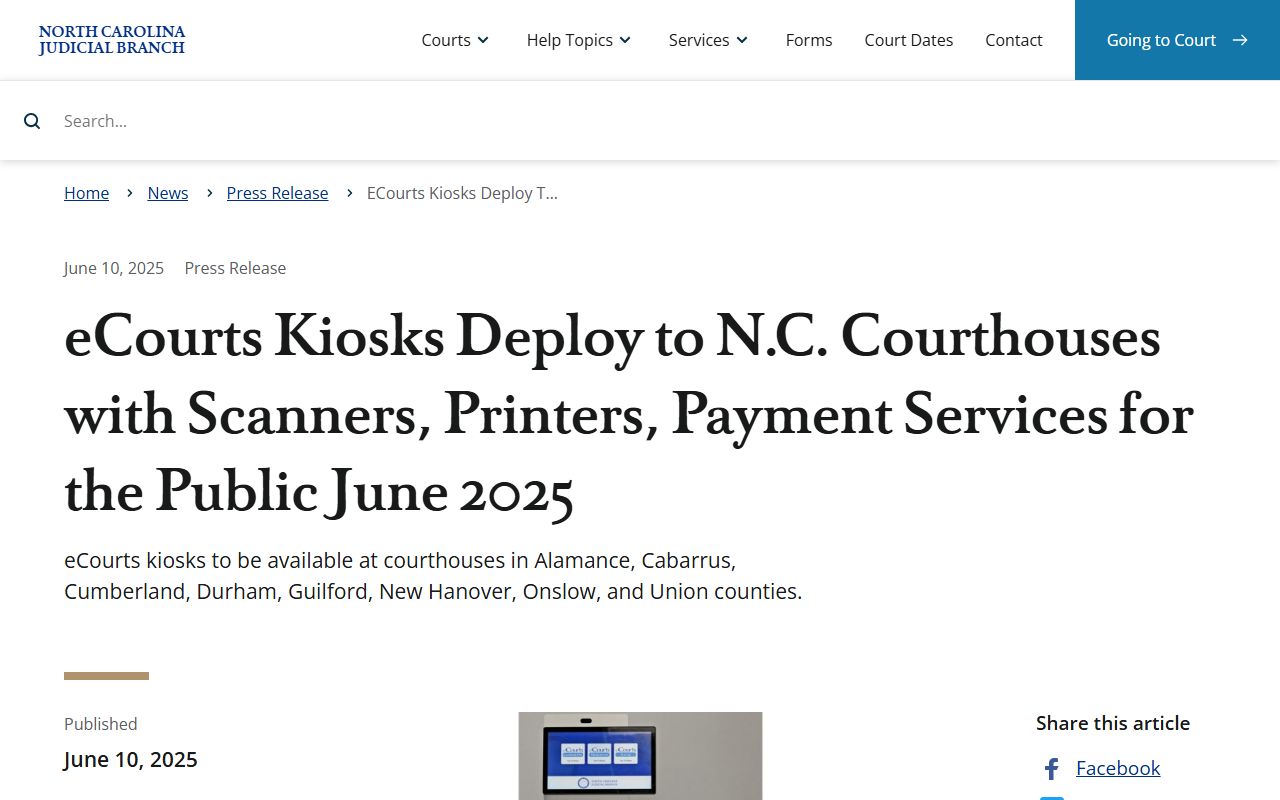
Kiosks matter for users who need courthouse access to scan, print, or pay without relying on home equipment.
The county's June 2026 budget release also signals continued investment in county services, including a Justice Services staffing note tied to mental health service expansion at the detention center.
The official Durham County budget notice gives the county context behind those service decisions.
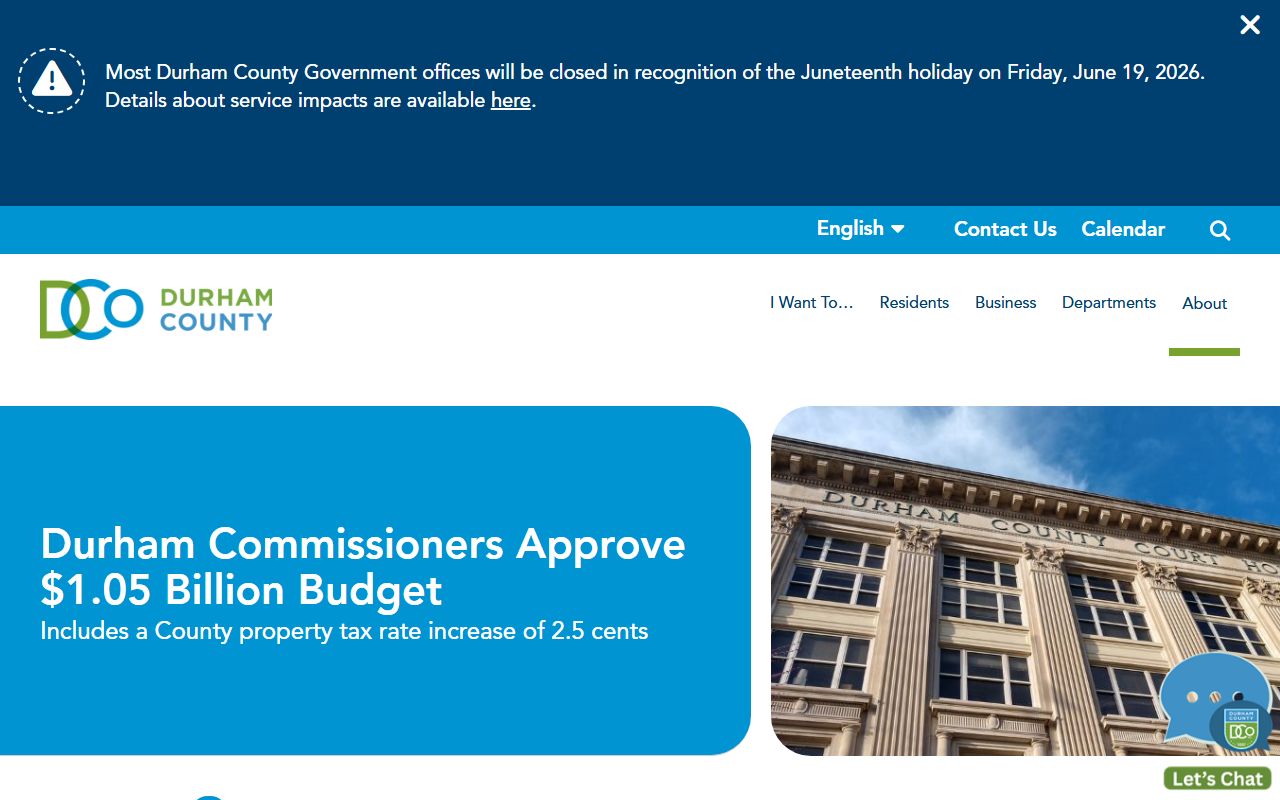
Budget and technology updates do not replace clerk records, but they explain why access channels and public-service tools can change during a court records search.
Durham County Court History
Durham County was formed in 1881 from parts of Orange and Wake counties, with Durham as the county seat. Its court history is tied to the city's growth from tobacco and textile industries into a research, university, medical, and technology center. The modern courthouse on South Dillard Street now anchors the local court system, with Superior Court, District Court, clerk services, jury service, magistrates, and case-management functions grouped in the downtown civic district.
Durham's legal ecosystem is also shaped by Duke University, North Carolina Central University School of Law, Research Triangle Park, large health systems, and a dense network of downtown attorneys and service providers. The local rules and forms for Superior Court, District Court, Domestic Court, and Juvenile Court show a mature local case-management system that is more specific than a generic statewide filing process.
The official Durham County landing page provides local court links, schedules, and service entry points for the current system.
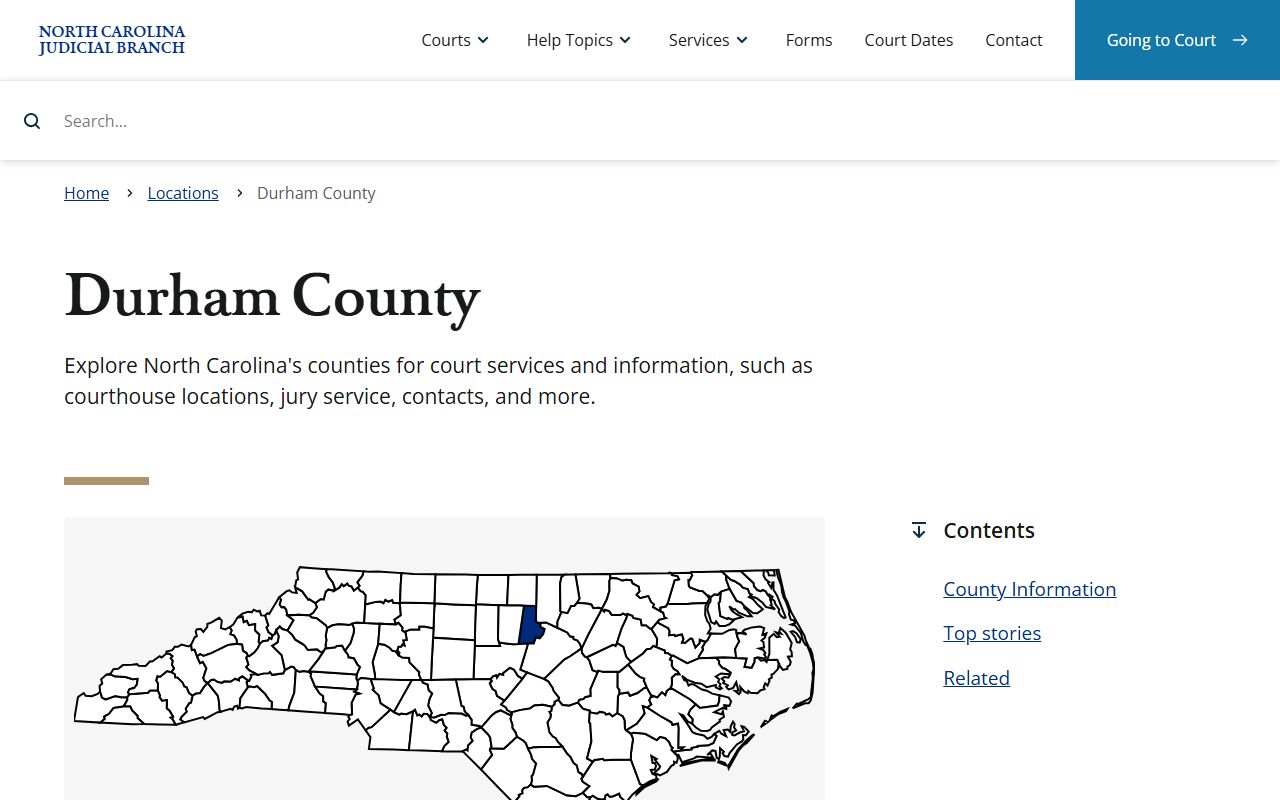
Those official location links help connect Durham's statewide court structure to the courthouse counters and phone lines a local records user actually needs.
Durham County Court Records FAQ
Can Durham County court records be searched online?
Yes. Public case information is searched through eCourts Smart Search, Search Hearings, NC Judgment Search, and the payment tools. Public terminals and in-person clerk review remain important for paper files, older records, certified copies, and background-check work.
Who keeps Durham County court records?
The Clerk of Superior Court keeps court records for the Superior Court and District Court divisions. The same clerk also serves as Judge of Probate for estates and special proceedings. The Register of Deeds is separate and handles marriage certificates, vital records, military records, and land records.
Are Durham County juvenile records public?
No. Juvenile delinquency, abuse, neglect, dependency, judicial bypass, emancipation, and many DSS-involved records are restricted under North Carolina juvenile law. Public Portal searches should not be treated as complete for restricted juvenile matters.
Where are Durham County warrant records searched?
No official public active-warrant database was found in the Durham research. Warrant status goes through the Sheriff's Criminal Investigation Division phone channel, the magistrate process for situational warrants, and later court or jail records after service or arrest.
How are Durham County divorce decrees requested?
Divorce judgments are Clerk of Superior Court records. Durham routes decrees less than 10 years old to Civil and decrees more than 10 years old to Judgments. A fee applies for copies when the divorce was filed in Durham County.